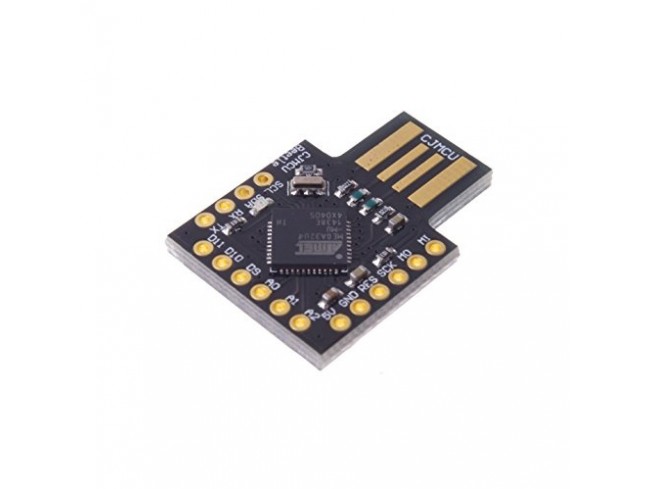
Description
The Beetle Arduino Leonardo USB ATmega32U4 Mini Board is an ultra-compact microcontroller designed for small-scale and embedded projects. Based on the same ATmega32U4 chip used in the Arduino Leonardo, it includes native USB communication—allowing it to function as a keyboard, mouse, joystick, or any HID device without extra hardware.
Despite its small size, the Beetle provides reliable performance for prototyping and final product integration. It is the perfect choice for wearables, smart gadgets, compact robotics, and educational electronics.
Beetle Arduino LeonardoKey Features
1. ATmega32U4 with Native USB
- Unlike boards that require an external USB-UART chip, the Beetle’s ATmega32U4 supports native USB, allowing it to appear as:
- Keyboard
- Mouse
- Game controller
- MIDI device
- Custom HID device
- Ideal for automation, custom input devices, and USB control projects.
2. Ultra-Compact Size
- One of the smallest Arduino-compatible boards on the market.
- Perfect for wearable electronics, physics labs, student projects, and embedded systems.
3. Fully Compatible with Arduino Leonardo
- Same USB capabilities
- Same IDE support
- Same libraries
- Same bootloader
This makes the Beetle a powerful tiny replacement for projects requiring Leonardo features.
4. Onboard Micro USB Port
- Easy programming and power supply
- No external programmer needed
- Works directly with Arduino IDE
Technical Specifications
- Microcontroller: ATmega32U4
- Operating Voltage: 5V
- Clock Speed: 16 MHz
- Flash Memory: 32 KB (4 KB used by bootloader)
- SRAM: 2.5 KB
- EEPROM: 1 KB
- I/O Pins:
- 10 digital I/O
- 4 PWM pins
- 4 analog inputs
- Communication: Native USB, UART, I2C, SPI
- USB Connector: Micro-USB
- Dimensions: Extremely compact mini form factor
Why Choose the Beetle Arduino Leonardo?
- Small size + full Arduino Leonardo power
- Simple USB plug-and-play programming
- Perfect for projects where Uno or Nano is too large
- Great for embedding into final products
- Excellent for rapid prototyping of USB devices
Applications
- Wearable electronics
- HID-based controllers
- IoT prototypes
- Compact robotics
- Smart sensing devices
- Education and rapid prototyping