Description
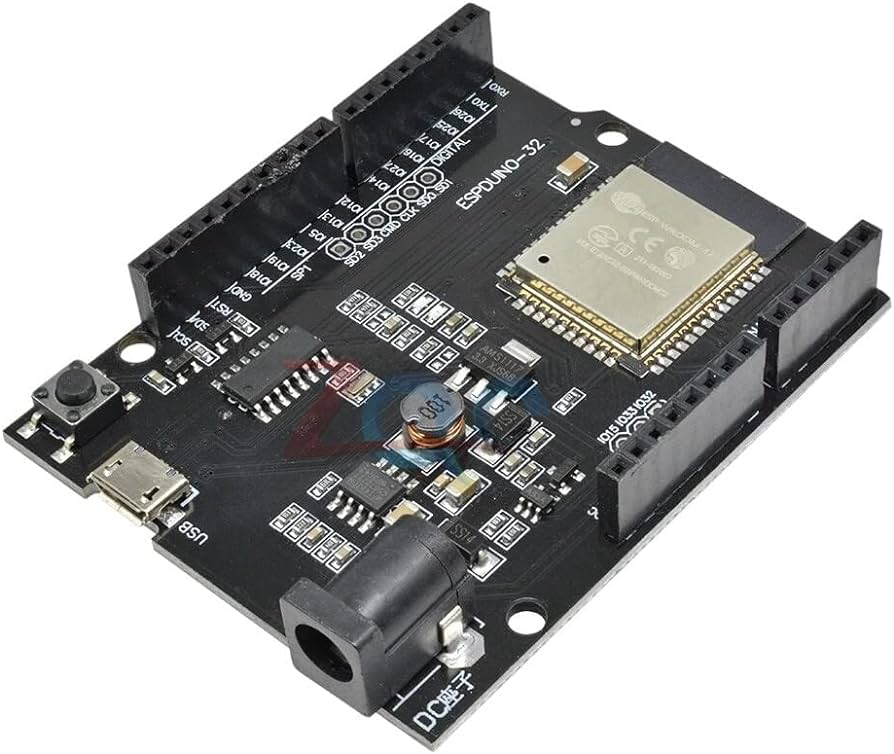
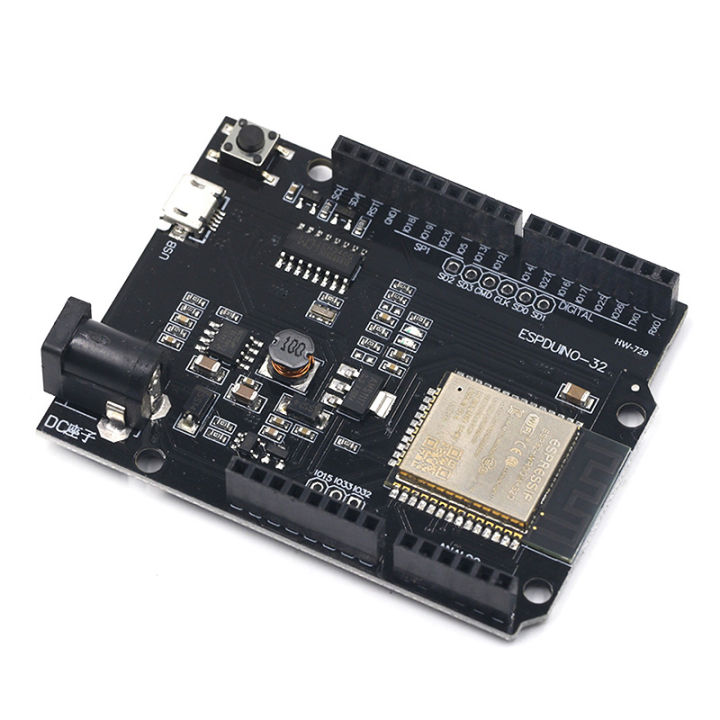
The WeMOS D1 R32 ESPDuino32 4MB Wi-Fi and Bluetooth Board is already integrated antenna and RF balun, power amplifier, low-noise amplifiers, filters, and power management module. The entire solution takes up the least amount of printed circuit board area. This board is used with 2.4 GHz dual-mode Wi-Fi and Bluetooth chips by TSMC 40nm low power technology, power and RF properties best, which is safe, reliable, and scalable to a variety of applications.
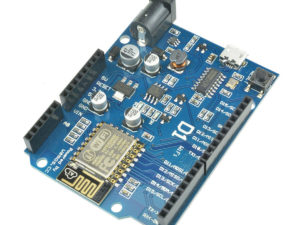
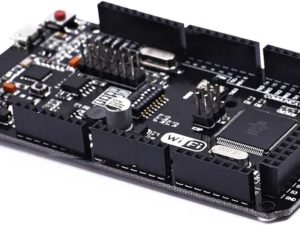
Wemos D1 R32 is ESP32 Based WiFi/Bluetooth Board in Arduino UNO form factor. The UNO form factor lets you use existing Arduino Shields with ESP32 Wireless CPU. All I/O pins are 3.3V
The ESP32 chip integrates a dual-core processor with 448 KByte ROM, 520 KByte SRAM, 16 KByte SRAM in RTC, 802.11 b/g/n/e/I Wi-Fi, Bluetooth v4.2 BR/EDR & BLE, clocks & Times, abundant peripheral Interfaces and security mechanism.
Software can be developed using many different platforms, including Arduino. It is designed for Generic low power IoT sensor hub, loggers, video steaming for camera, Wi-Fi & Bluetooth enabled devices, Home automation and mesh network applications, aimed at makers, hardware engineers, software engineers and solution provides.
The ESP32 is the most integrated solution for Wi-Fi + Bluetooth applications in the industry with less than 10 external components. ESP32 integrates the antenna switch, RF balun, power amplifier, low noise receive amplifier, filters, and power management modules. As such, the entire solution occupies minimal Printed Circuit Board (PCB) area.
WeMOS D1 R32 ESPDuino32 Superior Performance
At the heart of the WeMOS D1 R32 ESPDuino32 is the Xtensa® 32-bit LX6 dual-core processor, capable of running at 240 MHz. Compared to a standard Arduino Uno, this board offers significantly more speed and memory:
- Flash Memory: 4MB (vs. Uno’s 32KB).
- SRAM: 520KB (vs. Uno’s 2KB).
- Wireless: Built-in Wi-Fi and Bluetooth 4.2 (BLE) for seamless IoT connectivity.
Compatibility and Voltage Warning [!]
The WeMOS D1 R32 ESPDuino32 is designed to fit the physical footprint of the Arduino Uno R3. This means it fits perfectly into standard Uno cases and holders. However, it is crucial to note that the ESP32 operates at 3.3V logic. While you can power the board with 5V-12V via the DC jack, the Input/Output pins are not 5V tolerant. If you plan to use older Arduino shields that output 5V logic, you must use a logic level converter to prevent damaging the board.
Versatile Applications
Makers in Rwanda use the WeMOS D1 R32 ESPDuino32 for advanced applications where standard microcontrollers struggle. It is ideal for:
- Home Automation: Control lights and appliances via Wi-Fi using Home Assistant or Blynk.
- Remote Logging: Stream sensor data to the cloud in real-time.
- Internet Radio & Audio: Utilize the high clock speed and Bluetooth for audio projects.
Features
- Standard UNO size and headers
- CPU and Memory: Xtensa® 32-bit LX6 Dua-core processor, up to 600 DMIPS
- 4 MByte SPI Flash
- 448 KByte ROM
- 520 KByte SRAM
- Compact size of 68mm x 53mm x 3.1mm (±0.2mm)
- Supply Voltage: DC 5V to 12V
Technical Specifications
WiFi
- 802.11 b/g/n/e/i
- 802.11 n (2.4 GHz), up to 150 Mbps
- 802.11 e: QoS for wireless multimedia technology.
- WMM-PS, UAPSD
- MPDU and A-MSDU aggregation
- Block ACK
- Fragmentation and Defragmentation
- Automatic Beacon monitoring/scanning
- 802.11 i security features: pre-authentication and TSN
- Wi-Fi Protected Access (WPA)/WPA2/WPA2-Enterprise/Wi-Fi Protected Setup (WPS)
- Infrastructure BSS Station mode/SoftAP mode
- Wi-Fi Direct (P2P), P2P Discovery, P2P Group Owner mode and P2P Power Management
- UMA compliant and certified
- Antenna diversity and selection
Bluetooth
- Compliant with Bluetooth v4.2 BR/EDR and BLE specification
- Class-1, class-2 and class-3 transmitter without external power amplifier
- Enhanced power control
- +10 dBm transmitting power
- NZIF receiver with -98 dBm sensitivity
- Adaptive Frequency Hopping (AFH)
- Standard HCI based on SDIO/SPI/UART ? High speed UART HCI, up to 4 Mbps
- BT 4.2 controller and host stack
- Service Discover Protocol (SDP)
- General Access Profile (GAP)
- Security Manage Protocol (SMP)
- Bluetooth Low Energy (BLE)
- ATT/GATT
- HID
- All GATT-based profile supported
- SPP-Like GATT-based profile
- BLE Beacon
- A2DP/AVRCP/SPP, HSP/HFP, RFCOMM
- CVSD and SBC for audio codec
- Bluetooth Piconet and Scatternet
[!] Notes:
Do NOT use this board with 5V shields or the shields which are not compatible with 3.3V. These can shields permanently damage the board! Use only with 3.3V compatible shields and modules.
Get Started with Faranux
The WeMOS D1 R32 ESPDuino32 is fully compatible with the Arduino IDE (via the ESP32 board manager) and MicroPython. Order yours from Faranux Electronics today and take your projects to the next level of connectivity.